
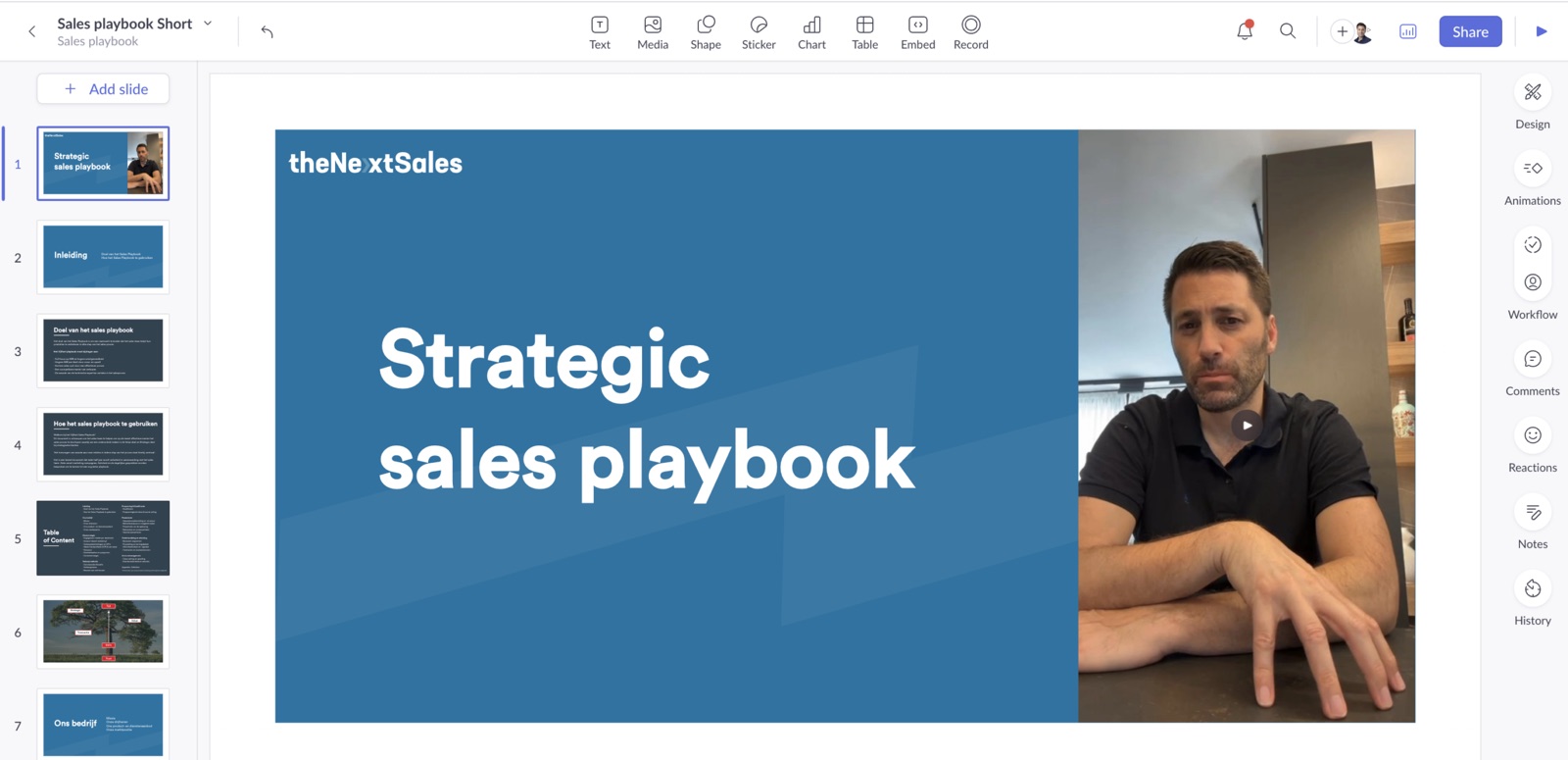
The Best Sales Pitch Deck in 20 Minutes
- Author
- Effy Shkuri
- Published on:
- Published in:
- Presenting

The 9 Steps to Your Sales Pitch
A sales pitch deck is an essential tool for a productive conversation. It’s the first impression you make on potential customers and an opportunity to present your value proposition in a concise and engaging way.
Here are some key steps for building a compelling sales pitch deck:
1. Start with the other person
When you begin your sales pitch, it’s important to start with what you already know about the person or organization you’re presenting to. It captures their attention (because who isn’t interested in themselves?). Plus, it shows that you’re a serious conversation partner and that you’ve done your homework. And it boosts the credibility of the solution you’ll present later on. You put the other person first, and that creates the ultimate goodwill factor.
Embedded video
This video is hosted by another company. As soon as it loads, that company sees your IP address and sets its own cookies.
2. Create a Calendar
Creating an outline for your presentation can help you organize your thoughts and convey your message clearly. It also serves as a roadmap for your audience, so they know what to expect and in what order the information will be presented. This reduces the likelihood of confusion and helps you present your points in a logical and coherent manner—it puts the mind at ease.
3. Another Problem Is (Still) on the Horizon
An effective pitch deck should not only focus on your product or service, but also on the problem you’re solving. This helps show your audience that you have a deep understanding of the issue and that you’re capable of providing a practical and effective solution. Make sure to explain this problem clearly and comprehensibly, usinganecdotes or storytelling whenever possible. The stage at which you use your pitch deck largely determines how specific you can be about the challenges and problems. It may be quite conceptual at the beginning, but should become very specific as you work toward a proposal.
“You’ve indicated that… however, we’re also seeing this happen”
4. False Hope “Sales Pitch”
An effective pitch deck also needs to build suspense and create disappointment—only to offer hope again afterward.
“This seems like an obvious solution, but it’s hard to sell internally.”
5. Present Your Solution
Now that you’ve identified the problem and explained your approach, it’s time to present your solution. This should be the core of your pitch deck, where you showcase the unique value of your product or service. Don’t forget to highlight the benefits and features of your solution, and why it’s the best choice for your target audience—here are some helpful templates.
6. Supporting Evidence with Results
Potential investors or customers want to know that your product or service works. By showing results or sharing case studies, you demonstrate the success of your solution. This could include successes with previous customers, tests you’ve conducted, or other evidence that your solution actually addresses the problem at hand.
7. Turn Risks into Opportunities
When presenting risks and countermeasures, it’s important not to focus solely on mitigating damage. Instead, try to transform risks into opportunities.
For example, if a client is concerned that the sales playbook you’re designing will end up gathering dust on a shelf (the risk), you can propose offering an adoption program in addition to developing the playbook (the countermeasure). This not only addresses the client’s concern but also provides an opportunity for you to deliver additional services and thereby increase the size of the deal.
By thinking this way, you can turn a potentially negative aspect of your proposal into a positive opportunity. Moreover, it shows that you’re proactively working with your client and focused on delivering success, which can help strengthen your credibility and build trust.
8. Identify the Success Factors
In this section, you will identify the key factors you need to succeed in the collaboration. These may include clear communication, timely decision-making, access to necessary information or resources, and so on.
Presenting these success factors has a twofold benefit. First, it helps your audience better understand what you need from them in order to be successful. Second, it allows you to maintain some control over the sales process by challenging the buyer to also invest in the success of the partnership.
It is important to present these success factors in a respectful and constructive manner, to show that you are looking forward to a partnership in which both parties are involved and add value. This way, you can lay a strong foundation for a long-term, successful business relationship.
9. Introduce Your Company and Summarize
Once you've covered the key points of your presentation, it's time to formally introduce your company and summarize what your audience has seen and heard.
Start with a brief description of your company, your mission, vision, and values. This helps provide a more complete picture of who you are and what you stand for as an organization.
Next, summarize the key points of your presentation, including the problem you’ve identified, your unique solution, the benefits for your audience, the potential risks and how you plan to address them, and the success factors necessary for an effective collaboration.
By ending your presentation this way, you can make a strong and memorable impression while reinforcing the key points of your message.
Furthermore, it shows that you don't just talk about who you are, but that you also demonstrate who you are through the value you offer and the approach you take.
Most Frequently Asked Questions
How should I use the sales pitch deck during the discovery phase?
During the discovery phase of the sales process, it’s crucial to strike a balance between gathering information and providing value. Your pitch deck should serve as a dynamic tool that fosters dialogue, rather than a static presentation. Start the conversation with targeted questions that help you understand the customer’s specific needs and challenges. Listen carefully and be flexible enough to adapt your presentation to the flow of the conversation.
As you listen, share relevant insights and the value your product or service can deliver, and illustrate these with short stories or case studies that resonate with the customer’s situation. This creates a sense of give and take, which makes a prospect more willing to share information. Use visuals from your deck to simplify complex ideas and invite feedback to foster a two-way conversation.
Remember that at this stage, you don’t need to force a sale; the goal is to build a relationship and establish trust. By sharing valuable insights and showing that you’re genuinely interested in the customer’s needs, you lay the foundation for a strong relationship and, ultimately, a successful sale.
How do I turn my sales pitch deck into a proposal?
To turn your sales pitch deck into a proposal, you need to refine and expand on the information from the pitch to create a document that covers the specific details of your offer and the client’s needs. Here’s a process you can follow:
- Summary of Needs: Begin your proposal with a summary of what you learned during the discovery phase about the potential client’s needs and challenges. This demonstrates that you have listened to them and understand their situation.
- Value Proposition: Use the key points from your pitch deck to formulate a clear value proposition. Link your solutions to the customer’s needs. Explain how your product or service solves these problems or meets these needs.
- Proven Results: Include case studies or testimonials from similar customers who have achieved success with your product or service. This builds trust and demonstrates the effectiveness of your offering.
- Offer Specifications: Be specific about what you are offering. Include product or service descriptions, prices, delivery times, and any other details applicable to the offer.
- Implementation Plan: Describe how you plan to implement or deliver the solution. This may include a timeline, project phases, milestones, and the level of involvement expected from the client.
- Investment and ROI: Create a clear overview of the investment required for your solution and link it to the expected return on investment (ROI). This will help you justify the cost of your product or service.
- Terms and Conditions: Include all terms and conditions, warranty information, support policies, and other legal details relevant to the purchase and use of your offer.
- Call to Action: Conclude with a strong call to action that encourages the prospect to take the next step. This could be scheduling a meeting to discuss the proposal, signing a contract, or taking some other specific action.
Make sure the proposal looks professional and reflects your company's branding. A well-structured and clear proposal can make all the difference in closing the deal.
Where can I incorporate storytelling?
You can incorporate storytelling into your pitch deck to convey your message more powerfully and leave a lasting impression on your audience. Here are a few strategies:
- Introduction: Start with a story that outlines the problem your product or service solves. This can be a hypothetical situation or an anecdote from an existing customer.
- Problem Statement: Illustrating the problem through a real-world story highlights its urgency and relevance.
- Solution: Present your solution as the hero of the story, with examples of how it has overcome customers' challenges.
- Success Stories: Instead of just showing testimonials, tell the story of the transformation your customers have experienced thanks to your product or service.
- Product or Service Description: Use narrative elements to describe how your product or service works in a realistic setting.
- Market Positioning: Tell your brand’s story and explain how it stands out from competitors in the market—perhaps by sharing the company’s journey or the philosophy behind the brand.
- Data and Statistics: Bring data to life by linking it to a story or example that makes the number meaningful.
- Vision for the Future: Conclude with a story about the future—what the world might look like with the widespread adoption of your solution.
By including these elements in your pitch deck, you can ensure that your presentation is not only informative but also engaging and memorable. Storytelling makes it easier for your audience to connect emotionally with your message and recognize the value of your offering.
What are some additional slides I might consider for a product pitch?
For a product pitch deck, the following slides are essential for effectively guiding the prospect through the product’s value proposition:
Demo or Product Tour Slide
- This slide should provide a visual and engaging presentation of the product in action.
- It could be a short video, interactive elements, or screenshots that highlight the user interface and user experience.
- The goal is to give the prospect a sense of how the product works and how easy it is to interact with the platform or solution.
Implementation and Support Slide
- This slide explains the solution's implementation process.
- It must include the timeline, the necessary resources, and the various phases of the rollout.
- It should also include information about the available support structures, such as customer service, training, and other resources designed to ensure a smooth transition.
Pricing Structure Slide
- This slide should clearly and transparently explain the pricing models and the various service packages or tiers.
- It is important to link the price to the value and to highlight any cost savings or ROI the customer can expect.
- Flexibility in pricing, such as volume discounts or personalized pricing options, can also be cited.
Customization Options for Slides
- Here, you describe how the solution can be customized to meet specific customer needs.
- Examples of previous modifications or customization options can help demonstrate the solution's flexibility.
- It's also an opportunity to highlight how your company works with customers to ensure that the solution delivers the desired results.
Can I include questions in the sales pitch deck?
In your sales pitch deck, you can include a question after every 3–5 informational slides to encourage interaction and discussion. Make sure these questions align with the content and guide the client through a narrative in which they recognize their own situation. Use closing questions that prompt action, and ensure the balance is appropriate for the complexity of your product and the dynamics of your audience. Feedback and adjustments are crucial for refining the balance between information and questions.
Effy Shkuri
"Our people make the difference." Really? As a former "digital workplace & IT entrepreneur," I've said this for years about my 25 colleagues. But the reality is we were only considered thought leaders by 5% of our target audience. Even today, this remains a common statement from MSPs and IT service providers. But these words lose their meaning if your expertise does not extend beyond your existing customers and a handful of prospects. I now help IT entrepreneurs with thought leadership in their niche.