
Storytelling examples for sales professionals (video)
- Author
- Effy Shkuri
- Published on:
- Published in:
- Playbook

1 – The Best Examples of Storytelling
Research has shown that a compelling story activates as many as seven different parts of the brain, unlike pure logic. This puts storytelling at the top of the list when it comes to effective communication.
Nevertheless, there is often a lack of storytelling examples that can be applied to specific situations. With this article, we aim to highlight the power of stories by presenting 15 practical storytelling examples that every salesperson can add to their arsenal.
After all, a compelling story is invaluable when it comes to building trust. Take, for example, the 18-minute TED Talks, which have been viewed millions of times worldwide.
The most popular among them succeed in evoking emotions in their audience by creating a storyline that’s easy to follow, which helps the message stick better. This article provides you with concrete examples of storytelling, which are essential for putting together the ultimate sales manual.
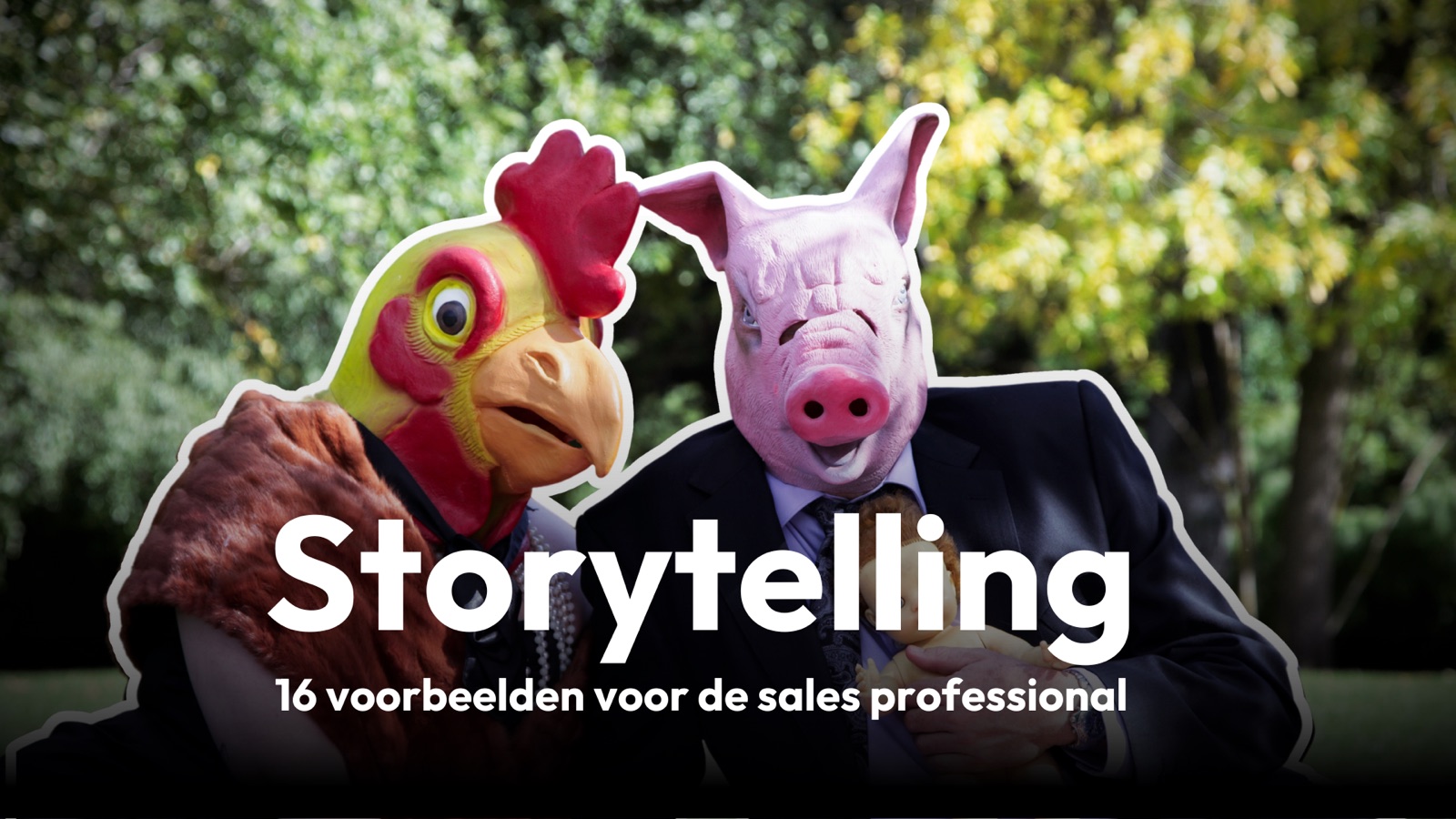
By the way, do you know the story of the chicken and the pig?
Embedded video
This video is hosted by another company. As soon as it loads, that company sees your IP address and sets its own cookies.
Sales Frames
Stories aren’t just useful at the beginning of the sales process to grab attention; they also play a crucial role in later stages, such as overcoming objections, building trust, and closing the deal. A well-chosen story can help the customer put themselves in the situation, visualize the benefits, and understand the value of your offer.
In the dynamic of sales conversations, storytelling can serve as a tactful shield against the “silverback” attitude of some conversation partners who try to dominate the conversation.
When a salesperson is faced with an assertive and dominant customer, it may feel instinctive to fight back with facts and figures to defend your position. However, this can often lead to a confrontation or a hardening of positions.
Storytelling offers an alternative approach: it enables the salesperson to “defuse” the conversation. By sharing a story that is relevant and engaging, the salesperson can shift the focus of the interaction from a power struggle to a shared human experience. Well-chosen stories can evoke emotions and empathy, causing the need for dominance to fade into the background.
The use of storytelling makes it possible to defuse a customer’s defensive behavior without direct confrontation. It builds a bridge toward common ground and understanding, and can help open up a conversation partner who is taking a hard line to a more equal and constructive dialogue.
It is a subtle art of building connections, creating a space in which even the most assertive conversation partner softens, listens, and ultimately wants to collaborate.
Storytelling and the use of“sales frames”are essential components of sales that are closely intertwined. A “sales frame” can sometimes be limiting, causing you to get stuck in a conversation. However, by telling a compelling story, you can break through this impasse. This creates a shift in authority, allowing you to take the lead in the conversation with your conversation partner.
These frames are crucial because they help shape the customer’s perception. By framing a story in the right way, you ensure that the customer interprets it in the desired manner. This significantly increases the likelihood of a successful sale.
In summary, by combining storytelling skills with effective “sales frames,” we can create a sales experience that is not only more engaging and persuasive, but also more customer-centric. This enables us not only to capture the customer’s attention, but also to leave a lasting impression. Ultimately, this leads to greater success in sales results, as we build a deeper connection with our customers and present our products or services more effectively.
Discover the art of storytelling in the context of the sales process. Here you’ll find a collection of powerful stories, carefully curated for salespeople.
16 Examples of Storytelling
Throughout my sales career, I’ve gathered countless stories and experiences. I’ve carefully selected the most insightful and compelling ones and summarized them in this blog. Each anecdote has been refined and adapted to specific sales situations, making them not only instructive but also immediately applicable in a variety of sales contexts. This blog serves as a rich source of firsthand knowledge and is a must-read for anyone who wants to improve their sales skills.
1. The Windblower 2. Bill Gates 3. The Comfort Zone 4. The Demonstration Trap 5. The Camel 6. Wasted Energy 7. The Chicken and the Pig 8. The Poet 9. Super Enthusiastic 10. King Willem 11. The Boat 12. The Elephant 13. Three Bananas 14. The Drunk Man 15. Gandhi 16. The CEO
1 – The Windblower
Situation
This storytelling example is about a situation in which a technical demonstration takes center stage in the sales conversation.
The prospect seems convinced that a new tool or software is the answer to his challenges, even though he has not yet fully defined or understood the underlying problem. He feels comfortable with his current solutions and is reluctant to implement changes, but does show interest in what new technology has to offer.
Storytelling Example
“I have an interesting story for you about a factory that produced packaging.
They were facing a challenge where empty boxes were coming off the production line too often.
After investing millions in consultants and engineers, they came up with a sophisticated technical solution: a complex system of sensors to detect these empty boxes.
But John, a regular employee, had noticed the problem earlier and decided to place a blower at the end of the conveyor belt.
What do you think?
It worked perfectly.
Empty boxes were simply blown off the conveyor belt.
And do you know what's great about this story?
"We are John."
Smile.
Morale
It's difficult to change a prospect's mind once the direction of the solution has already been determined.
“The man with the hammer sees only nails”
Advice
Use this story when a client is inclined to request a demonstration or presentation of a technical solution without first clarifying the actual problem. It emphasizes the importance of first understanding the core of the problem before getting carried away by technical solutions.
2 – Bill Gates walks into a bar
This storytelling example was created specifically for the prospecting phase, but can be used in a variety of ways.
View this presentation (opens elsewhere)
3 – The Transformation
Situation
A potential client is very interested in your services but has questions about the hourly rate. They’re used to working on a time-based basis rather than a value-based one, and are a bit hesitant because they think your rate might be higher than what they usually pay. They want to understand why they should pay more for your services and what they’ll get in return.
A man arrives at the gates of heaven and complains about why he has to leave at the age of 40. It turns out to be a misunderstanding, because they had based their calculation on the number of billable hours. And based on that, he was estimated to be 105 years old.
Morale
It’s essential to focus on value rather than just hours. Change your perspective, or you’ll end up disappointed.
When you're asked about your hourly rate, tell this story to emphasize the value you provide rather than the amount of time you spend. It helps the client understand that quality and value take precedence over quantity.
4 – The Demonstration Fall
A potential client is considering working with your organization but has reservations because of the size of your company. They are used to working with larger, well-established organizations and wonder whether your team can meet their needs. They doubt whether your approach will be effective, given that you are smaller than the organizations they normally work with.
Storytelling Example
On a beautiful day, on the banks of a tranquil river, two teams were ready for the race of their lives. On one side were the wise, with one coxswain and eight rowers. On the other side were the fools, with eight coxswains and only one rower.
When the starting signal sounded, the wise men moved forward steadily and in unison. The fools, on the other hand, fought among themselves over the best route, causing their sole rower to become exhausted.
By the end of the race, the wise men had a clear lead. In an attempt to correct their shortcomings, the fools decided to hire a manager to “optimize” the next race. But when they lost again, they chose to fire their only rower.
Just like in this story, we believe in the power of efficiency and the right team. With us, you don’t pay for unnecessary overhead or too many managers. You invest in the rowers—the ones who actually do the work.
When customers have questions about your approach or the size of your organization, use this story to emphasize the value of efficiency and a focus on results.
5 – The Camel
The client is currently in talks with various vendors regarding an IT solution, and one of the competitors is offering a package with a plethora of features, many of which are not directly relevant to the client’s needs. The client is impressed by the number of features, but also feels overwhelmed and is unsure about the actual added value of all these features for their specific situation.
“Mom,” asked the young animal, “why do we actually have humps on our backs?”
“Sweetheart,” the mother camel began, looking at her tenderly, “those humps store water. In the desert, it can take days before we find water again. Thanks to these humps, we can travel long distances without running out of water.”
“And why do we have such wide, rounded feet?” the young one asked.
“Our feet are designed so that we can walk easily across the hot sand without getting stuck. Every part of us is adapted to the desert,” the mother explained.
The young one thought for a moment and then asked, “And our long eyelashes—what’s the reason for those?”
“They protect our eyes from the blowing sand and the bright sun,” the mother replied proudly.
After thinking for a moment, the young camel said with a frown, “So we’re completely adapted to the desert—with our humps to store water, feet to walk on sand, and eyelashes to protect our eyes… But then why are we living in a zoo, far away from the desert?”
Just as the camel has unique features specifically designed for the desert, many IT solutions offer features that may not be relevant to your needs. It’s essential to focus on what actually adds value and not get distracted by unnecessary “bells and whistles” that larger players may offer.
When comparing your services to those of competitors who offer a plethora of features, use this story to emphasize the value of customization and relevance. You don’t have to pay for features you don’t need or that don’t really offer any benefit in your specific situation.
6 – Lost Powers
The customer is considering your product, but has found a cheaper alternative from a competitor. Although your product better meets their needs and offers more value in the long run, the customer is still drawn to the lower cost of the alternative. They are unsure whether the extra money they would spend on your product is justified.
A camel lived in a world-famous zoo, where he had grown up from a young age. His habitat had been designed with the idea that he would never set foot in the desert, so he was surrounded by greenery and a pleasant little lake. Many visitors admired him, but many also wondered why an animal meant for the desert was being kept in such an environment.
The zoo had concluded that, since the camel would always remain within its enclosure, it did not need the strength and capacity of its humps—which are essential for long journeys through the desert. They maintained his diet and living conditions in such a way that he would never reach his true potential, causing him to look thin and underdeveloped compared to his wild counterparts.
However, for reasons beyond their control, it was decided one day that the camel should be set free in the desert. Without any preparation, he was sent out into the vast sandy plains, where the sun beat down relentlessly and water was scarce.
In the first few days, the camel tried to adapt to its new surroundings. But it lacked the strength and stamina that its wild counterparts possessed. Its humps, which hadn’t been used for their primary purpose in years, couldn’t compensate for the lack of water.
Despite his efforts to survive, the desert was unforgiving. Without proper preparation and his natural strength, the camel died alone, far from the zoo that had once been his home.
Just like the camel that was stripped of its strength and essence, choosing a cheaper option that doesn't offer all the necessary features can lead to unexpected and tragic consequences in practice.
Recommendation:
If a customer questions the value of your product because of its price compared to a competitor’s, share this story. Explain that not all solutions are the same and that it’s crucial to understand what someone really needs, rather than just looking at the cost. A short-term savings can end up costing more in the long run.
7 – The Chicken and the Pig
In a quiet corner of a bustling farm, Chicken sat daydreaming under an apple tree. She had been dreaming for a while about starting her own business. One day, with a glimmer of determination in her eyes, she walked over to Pig.
“You know, Pig,” Chicken began, “I’ve always dreamed of having my own little restaurant here on the farm. A place where all the animals can enjoy the most delicious breakfasts!”
Pig, known for his practical approach and love of food, was intrigued. “That’s an interesting idea, Chicken. But what did you have in mind to serve?”
Chicken, excited, blurted out, “Let’s call it ‘Bacon and Eggs’! Wouldn’t that be fantastic?”
Pig swallowed hard. He realized the implications of what Chicken was proposing. While Chicken would be contributing her eggs without too much sacrifice, he would have to give up a large part of himself for the bacon.
His eyes darkened. “Kip,” he said softly, “for you, it’s a simple contribution, but for me, it’s the ultimate sacrifice.”
Chicken stared into space for a moment, taking in the weight of her proposal. “You’re right, Pig,” she sighed. “We need to find a way for both of us to contribute something meaningful, without either of us having to sacrifice too much.”
True cooperation requires an understanding of the commitment and sacrifice of everyone involved. What may be a small contribution for one person can represent the ultimate sacrifice for another.
Use this story when you notice that a client wants to work with you but wants to place most of the risks and effort on you. It illustrates the importance of mutual respect and equal commitment.
8 – The Poet
You are in a conversation with a customer who has shown interest in your product or service. However, despite the positive signs, the customer remains hesitant to make a final decision.
He asks for more information, additional demos, and perhaps even a price reduction. You start to doubt the customer’s true commitment and wonder if he really sees the value your solution can bring him.
You realize that it's time to help the customer see the true value and evaluate his own commitment to the solution.
In New York’s picturesque Washington Square Park, Leo, a poet, was reading his latest poem aloud. The words flowed like water, and the crowd was visibly moved by the emotion he poured into every word. As the poem progressed, people began to clap, creating a rhythmic accompaniment that made his words even more powerful.
As the poem drew to a close, the crowd turned around one by one and left, the rhythm of their applause still ringing in their ears. However, one young woman remained standing, her eyes shining with emotion. She walked over to Leo and said, “Your words… they’ve changed my life. They’ve made me realize what’s truly important.”
The poet, visibly moved by the impact of his art, saw an opportunity. “Thank you,” he replied. “If you’d like, I have a collection of my poems for sale for just five euros.” The young woman smiled somewhat shyly and said, “No, that’s not necessary.”
Leo, still overwhelmed by the irony of the moment, watched her walk away and thought aloud, “If my poem changed her life, how much is that life worth?”
Morale
Enthusiasm doesn't always translate into a purchase. Words without action are just words.
Advice
Tell this story if you want to know whether the client is serious. By subtly referencing “The Poet of Washington Square,” you can encourage the client to reflect on their own commitment and the value they truly place on the solution you’re offering. It can serve as a starting point for a deeper conversation about what the client really wants and whether they’re willing to take the necessary steps.
The question about the business case can then follow. If the customer truly believes in the value of what you’re offering, a business case should be nothing more than a formality—a confirmation of what they already feel. However, if they still need to be convinced of the value, then the business case is essential.
9 – Super enthusiastic
You’re in a meeting with a potential client who has repeatedly expressed how impressed he is with your company, services, or products. He’s full of praise for the quality of your work, the professionalism of your team, and the innovativeness of your solutions. However, despite all these words of praise, you notice that the client remains hesitant when it comes to actually making a financial investment or committing to a deal.
During a business meeting, a client kept praising our sales playbook and online platform. He even went so far as to say that we were underestimating our own worth and that we should actually be charging more. But when it came time to renew the contract, his true colors showed. “I’m sorry,” he said, “but we can’t make the business case work.”
Praise is just empty words if it isn't followed by action. True appreciation is shown through actions, not just words.
Use this story when a customer gives you lots of compliments but is hesitant to make a purchase. It reminds them that actions speak louder than words.
10 – King Willem
Situation
The room is packed, and you’re getting ready for that important presentation. You’ve just started when you’re immediately asked a very complex question. You’re tempted to answer the question, but a correct answer isn’t really possible. You feel like your back is against the wall, and you can feel the pressure. You also realize that the person asking the question is trying to throw you off balance. What do you do?
King Willem had a soft spot for Eddy, which aroused jealousy in one of the courtiers. To belittle Eddy, the courtier asked him three difficult questions, starting with, “How many stars are there in the sky?” Without a moment’s hesitation, Eddy pointed to a sheep in the distance and replied, “There are as many stars as there are hairs on that sheep. Feel free to count them.”
Facing an impossible question calls for a clever answer. Sometimes the best approach is to turn the question back on the asker and show them how unreasonable their question is.
Use this story when you’re faced with unrealistic demands or requests from a customer. It helps restore balance and encourages the customer to reflect on the reasonableness of their request. This is especially valuable during negotiations or when addressing objections in general.
11 – The Boat
You’re sitting at the table with the CFO of a medium-sized organization, who has high expectations and demands regarding your cybersecurity services. The CFO asks for more comprehensive protection, better security measures, and stricter regulatory compliance, but indicates that he believes this is the responsibility of the IT manager and not his own.
On a quiet day, a group of people is on a boat out on the open sea. Suddenly, one of them pulls out a drill and starts drilling under his own seat. Shocked, his companions exclaim, “Why are you doing this?” The man looks up and says, “Don’t worry, I’m only drilling under my own seat.”
The CFO looks at you and says, “This isn’t my responsibility; it’s the IT manager’s job to address cybersecurity issues.”
This story highlights that, within an organization, every employee plays a role in the bigger picture. What one person does affects everyone. In this case, the CFO is ultimately responsible for the organization’s overall security. If the ship sinks and the company goes bankrupt due to a lack of cybersecurity, that is a business problem for which the CFO is responsible.
Use this story to remind the CFO that cybersecurity is an integral part of business operations and that, as CFO, he bears ultimate responsibility for ensuring the continuity of the business. It’s a good story to use to start a discussion about how he can work with the IT manager to address cybersecurity risks and ensure a secure and resilient organization. Collaboration and shared responsibility are crucial to protecting the company from potential threats.
12 – The Elephant
Situation
You’re talking to a customer who wants to see a quick solution to their problem, without first taking the time to fully analyze it. They may be impatient or have had a previous bad experience with another provider who acted too hastily.
Six blind men wanted to know what an elephant looked like. Everyone was standing so close to the elephant that no one could tell if it was an elephant.
Every person has their own perspective based on their own experiences, and that perspective can be completely different from reality or someone else’s perspective.
Use this story to emphasize the importance of fully understanding the situation before drawing conclusions or making decisions, and to illustrate the value of your thorough approach. This can serve as an interesting storytelling example to present a value assessment.
13 – Three Bananas
You’re in the middle of negotiations with a client, and the process seems to have stalled. The client is fixated on the cost and doesn’t seem to recognize the full value of your offer. The client keeps pushing for price reductions, putting you in a difficult position and forcing you to break the deadlock.
I've been thinking about our previous conversations, and I realize that I may not have been as clear as I could have been about the true value of our offer. I appreciate the time and attention you've devoted to our negotiations, and I want to make sure you have all the information you need to make an informed decision.
Let me share a short story to illustrate my point: A zookeeper told his group of monkeys that they would get 3 bananas in the morning and 4 in the afternoon. The monkeys were unhappy. When he suggested giving them 4 bananas in the morning and 3 in the afternoon instead, they were happy, even though the total number of bananas was the same. This story shows how the perception of a situation can change depending on how it’s presented.
I wonder if we might be in a similar situation. Perhaps I didn't present our proposal in the best way, and I'd like to take this opportunity to sit down together, discuss the unique value we offer, and make sure everything is clear and transparent.
Let's shift our focus from price to value, and work together to ensure that you fully understand what you're getting for your investment. I'm confident that if we consider the full scope of what we offer, we can reach an agreement that is fair and beneficial to both of us.
In business communication, it is important to realize that sometimes a change in wording can make a big difference in how something is perceived, even if the actual offer remains unchanged.
“Flexibility in thinking and a willingness to change our perspective can lead to satisfying solutions, even when it seems like we’re stuck.”
This story may encourage the buyer to reconsider his position, and it can help break the deadlock in negotiations by introducing a new way of thinking. It encourages collaboration and emphasizes the importance of open dialogue and creativity in problem-solving.
This story is best suited for the negotiation phase, especially when you’re looking for ways to break the deadlock without undermining your credibility or the value of your offer. It helps shift the focus from cost to value, and it creates a sense of urgency to reach an agreement.
Use this story strategically and make sure it fits the context of the negotiation. It’s important that the story comes across as sincere and relevant so that it has the desired impact.
14 – The Drunk Man
You find yourself in a situation where the customer feels comfortable with their current solutions and approaches, even if they aren’t optimal. They may be hesitant to make the switch to a new technology or solution because they fear the unknown, even though they realize that their current solution isn’t adequate.
One night, a police officer sees a drunk man searching under a streetlight. He decides to help and asks what the man has lost. “My car keys,” the man replies.
After searching unsuccessfully for a while, the officer asks the man where he lost his keys. “Across the street,” says the drunk man. Surprised, the officer asks why he’s looking here, then. “Because the light is better here,” the man replies. This story illustrates how people sometimes look in the wrong places because it seems easier or more comfortable, not because it’s the most logical place.
Don’t let your comfort zone hold you back; the best solutions sometimes require us to explore the unknown and take risks. With this advice, you can help the client broaden their perspective and be open to new, potentially more effective solutions that your company offers. It emphasizes the importance of seeking out the right solution, rather than the easiest or most familiar one.
This story works well for persuasion during the prospecting phase. The problem is clear, but the prospect seems stuck in their old ways of thinking. It’s a way to spark the prospect’s interest with a smile—without offending them—by using a joke to explain how you view the situation. Timing and the relationship are crucial here, and this approach is recommended when you’ve been working on the deal for months but haven’t been able to make a breakthrough. Only once your contact is convinced of your perspective will you have a potential champion who can help you move forward.
15 – Gandhi
This situation is relevant in a sales context where you need management to support or implement a change. It illustrates the importance of credibility and of following your own advice before advising others.
It is a clear, sunny day, and the tension in the air is palpable as a mother and her child prepare to meet Mahatma Gandhi, the great leader and spiritual guide. After an exhausting journey on foot, they finally reach their destination, their hearts full of anticipation and hope. When Gandhi greets them with a warm smile and asks how he can help them, the mother shares her concern: “My child eats too much candy, and I’m worried about his health. Could you please talk to him and tell him he needs to stop?”
Gandhi, with his piercing gaze and thoughtful demeanor, pauses for a moment to reflect and then says, “Come back in a month.” Surprised but respectful, the woman agrees to his request, and they leave, leaving her somewhat confused.
A month later, they return, their hopes and expectations renewed. When Gandhi sees them, he turns to the child and simply says, “Stop eating candy, my child.” The woman is surprised but grateful. However, before she leaves, she can’t resist asking, “Why didn’t you say this last month?” Gandhi replies calmly, “Because I was still snacking myself last month.”
The moral of the story is that you must be the change you want to see in others. It emphasizes the importance of credibility and practicing what you preach.
In a sales context, use this story to emphasize how important it is for management to fully support and believe in the changes you’re proposing. It is essential that they lead by example and embrace the proposed changes so that the rest of the organization will follow. This story serves as a powerful reminder that to have credibility and influence others, you must live by the principles you promote. Management plays a crucial role in setting the tone and creating an environment where change is possible.
16 – The CEO
This story is a real-life case in which, as an IT service provider, I had to deal with unexpected problems following a major investment. The implementation was rocky, and I have some news.
I remember a situation about 10 years ago when I found myself in the middle of a storm with one of our clients. They had just made a significant investment in a new product, but shortly after implementation, it was announced that the product had been declared “End of Life.” This information had been kept secret by the supplier until the very last moment, so no one—including us—had seen this coming. The client’s investment amounted to half a million euros, and as you can imagine, they were anything but happy.
When the day of the meeting finally arrived, the CEO presented his product and its benefits with great conviction. He assured the client that his team was ready to guide us through this difficult period. When the client asked about the size of the company, the CEO replied calmly, “We have 10 employees.” The client, still skeptical, responded, “I just invested half a million, and now I’m supposed to put my trust in a company with 10 employees?”
The CEO, however, remained unfazed and replied, “This year, you’ve done business with a company that has 100,000 employees, and look where we are now. Besides, you’re not the only one who believes in us. We now have 30 major companies that trust us.”
The size of an organization does not necessarily determine its success or reliability. A smaller, dedicated team can sometimes be more reliable and competent than a large company.
This story can be used to emphasize that the focus should be on the competencies and reliability of a team or company, not on its size. It helps restore trust and reassure the customer that a smaller team can sometimes be the better choice, especially if that team already has the trust of other large organizations. In crisis situations, it’s important to remain calm, take a solution-oriented approach, and be open to alternative solutions.
The Future of Storytelling for Salespeople
In this article, we have highlighted the crucial role of storytelling in the sales process, with an emphasis on using stories for effective communication and leveraging “sales frames” to achieve better results. The fifteen concrete examples discussed here serve as a practical guide for salespeople to hone their skills and make a greater impact in their interactions with customers.
From overcoming resistance in the story of “The Windblower” to reframing perspectives in “The CEO,” each story offers unique insights and tactics for building relationships, gaining trust, and achieving sales success. These stories empower salespeople to transform their communication style, enabling them not only to convey information but also to evoke emotions and leave a lasting impression.
The Power of Sales Frames
The use of sales frames, as discussed in detail in Section 1.3, links storytelling with strategic sales. This equips salespeople with the tools to present their message in a compelling and powerful way. It enables them not only to compete for the sale, but also to captivate the customer, thereby building a deeper connection with them and creating an environment in which deals are closed more quickly and efficiently.
How Salespeople Create Their Own Stories
Salespeople can create their own stories by documenting personal real-world experiences and placing them in the context of the current sales phase. This process begins with reflecting on and analyzing significant sales moments, challenges, successes, and failures. By writing down these experiences, a salesperson can identify the key points and emotions that emerge at each stage of the sales process. These personal stories can then be transformed into powerful anecdotes that resonate with the customer’s situation and needs.
This approach helps salespeople create authentic and relevant stories that not only showcase their experience and expertise but also speak directly to the customer. It enables them to move beyond traditional “sales pitches” and engage in a more meaningful and memorable dialogue with the customer.
In conclusion, storytelling isn't just an optional extra in sales; it's a fundamental skill for every salesperson. So what's your story, and what makes you the thought leader in your niche?
Most Frequently Asked Questions
What Is Classic Storytelling from Disney’s Perspective?
The classic steps of a story, often used in the context of storytelling—including the Disney formula and the “Story of One”—are generally as follows:
- Once Upon a Time: This is the introduction that describes the main character’s normal world or everyday situation. It provides context for the listener or viewer.
- Every Day: The daily routine or status quo is established. This shows the initial situation or the problem the main character is facing before anything changes.
- Until One Day (Tot op een dag): This is the pivotal moment when something happens that disrupts the daily routine. It is the defining incident or catalyst that sets the story in motion.
- Because of That: This describes the sequence of events that occur as a result of the triggering incident. It is often a series of attempts and failures, learning processes, and small victories.
- Until Finally: The climax of the story in which the main character faces their greatest challenge or solves their biggest problem.
- And Ever Since Then: This is the resolution or conclusion that describes the new status quo. It explains how the protagonist's world has changed and what lessons have been learned.
This structure is popular not only because it gives a story a satisfying arc, but also because it reflects the natural way people process and remember information. In business storytelling, these steps are adapted to tell a brand story, describe a product innovation, or recount a business transformation.
What is the power of “the story of one”?
The “Story of One” is a narrative technique often used in storytelling as well as in the fields of data presentation and journalism. The idea is to center a story or presentation around a single individual, example, case study, or experience. This technique is used to personalize abstract data, major issues, or complex ideas, making them relatable and understandable to the audience.
Instead of talking about large groups or presenting impersonal statistics, the focus is on the personal story of a single person or object. This makes it easier for the audience to connect emotionally with the subject and remember the message more effectively.
In a business context, it can be used to illustrate the impact of a product or service by showing how it has changed one person’s life. In journalism, it can be used to emphasize the human interest angle in a news story. The “Story of One” can be a powerful tool for fostering empathy and increasing engagement.
What is the pitfall of storytelling?
The art of storytelling can easily go off the rails if the story revolves too much around the storyteller rather than the audience. A story loses its power if it becomes too complicated, lacks sincerity, lacks a clear structure, or neglects the emotional connection. Predictability and an overly sales-oriented focus can turn listeners off. Furthermore, ignoring the unique characteristics of different communication channels and failing to include a clear call to action can prevent the message from getting across. Finally, it is crucial that a story does not create expectations it cannot fulfill, as this can damage the audience’s trust. To be effective, storytelling must strike a balance between being informative, emotional, and entertaining, always with a clear focus on the listener.
How can I make sure my story resonates with my audience?
To make a story memorable, it must resonate emotionally and convey a universal value or message. Use vivid, sensory language and concrete imagery to bring scenes to life. Structure the story with a clear conflict and resolution, and repeat the core message in creative ways. A strong ending or an unexpected twist can help anchor the story in the audience’s memory.
In what ways can I use storytelling to simplify things?
Storytelling can make complex information accessible by using metaphors and analogies that are familiar to the audience. Start with a relatable scenario to set the stage, and guide the audience through the story with simple, step-by-step explanations. Visual aids such as diagrams, images, or narrative videos can also help simplify and clarify complex concepts.
Effy Shkuri
"Our people make the difference." Really? As a former "digital workplace & IT entrepreneur," I've said this for years about my 25 colleagues. But the reality is we were only considered thought leaders by 5% of our target audience. Even today, this remains a common statement from MSPs and IT service providers. But these words lose their meaning if your expertise does not extend beyond your existing customers and a handful of prospects. I now help IT entrepreneurs with thought leadership in their niche.