
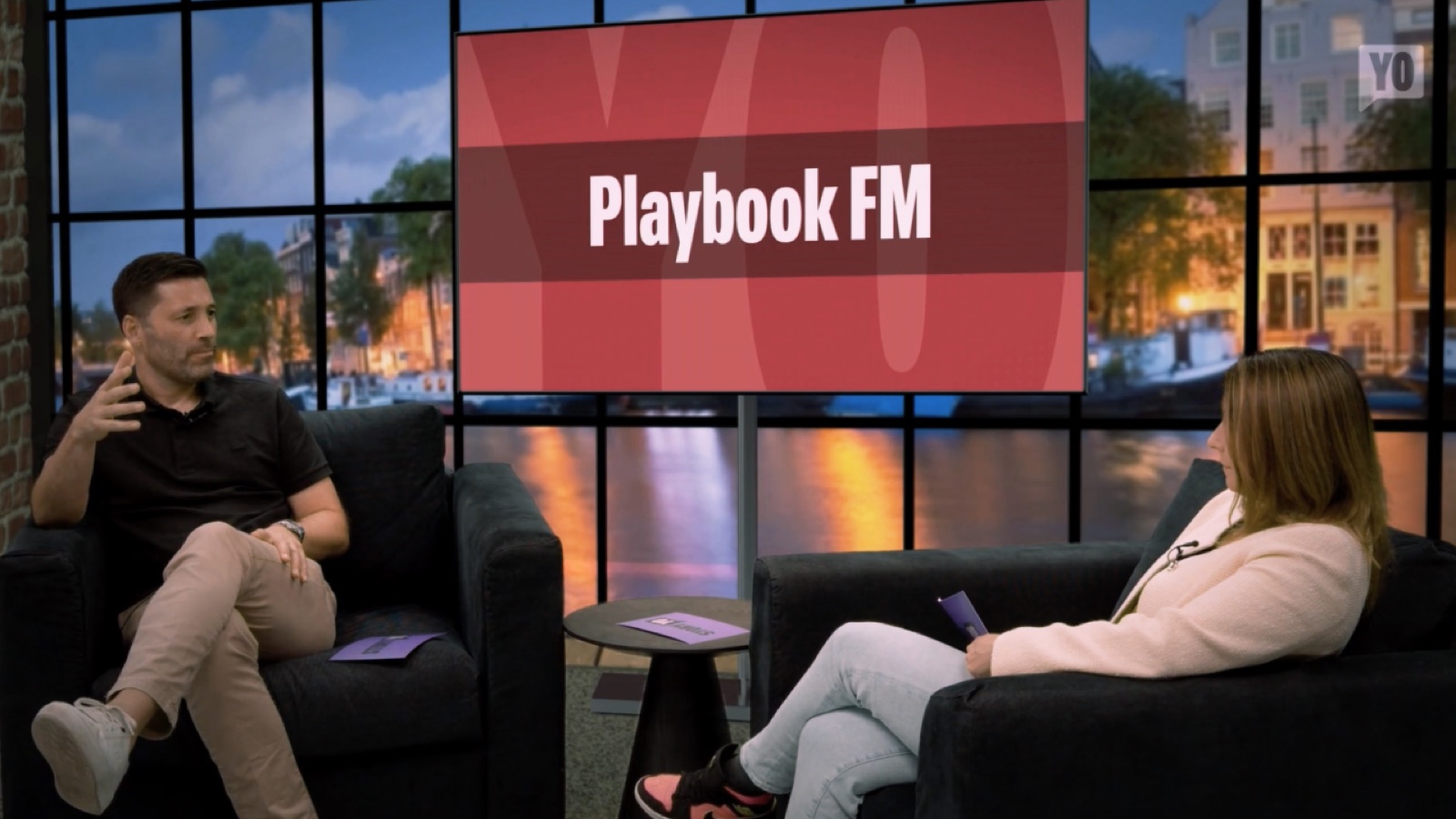
Sales Playbook: How to Sell More Effectively in 12 Steps (video)
- Author
- Effy Shkuri
- Published on:
- Published in:
- Playbook

What is a sales playbook?
A sales playbook serves as the ultimate blueprint for every aspect of the sales process. This dynamic document—ideally hosted digitally—not only outlines the strategies and tactics essential for maximizing sales results, but also provides insight into ideal customer profiles and the behaviors required for success.
Embedded video
This video is hosted by another company. As soon as it loads, that company sees your IP address and sets its own cookies.
Every sales playbook is custom-built to align with a company’s unique products, services, and value proposition. As a strategic guide, the playbook aims to provide salespeople with a clear and consistent framework that increases efficiency and optimizes sales performance within the company. “In sports, a sales playbook describes the strategy and desired actions for each situation based on a specific system of play.”
Who is the sales playbook for?
The sales playbook is valuable for every sales organization and every sales professional. In addition, a playbook is also valuable in a broader sense for customer-facing professionals, such as consultants, customer service representatives, and marketers.
The structure of the playbook depends on the type of organization and the process. In general, a playbook becomes increasingly valuable as the organization grows.
In that case, success is even more reproducible because there is simply better data, and as a result, so-called best practices are no longer based on arbitrary information.
For example, it’s easier to draw a reliable conclusion based on 500 won or lost opportunities than on just 50. The insights gained from a thorough analysis help iron out the kinks.
Why should you use a sales playbook?
On average, it takes three months for a new salesperson to build a solid enough foundation to have a meaningful conversation, nine months to develop the necessary skills to perform effectively, and 15 months to reach top-performer status.
For many organizations, the time it takes to achieve success is often longer than they would like. It is therefore important not to spend too much time experimenting, but to work toward a sales strategy that works.
“You don’t want to bake a different cake every time”
1 – Shorten the curing time
Given the average length of employment of 18–24 months, reducing the onboarding period is a top priority.
A sales playbook ensures that salespeople immediately understand what they need to know to be successful. While it may seem to give salespeople less leeway to approach the sales process intuitively, this does not mean that the salesperson’s creativity is not welcome.
The sales playbook is actually designed to help salespeople excel in creativity within a specific framework—it’s still the salesperson who makes the difference.
At the same time, a sales playbook also ensures that less energy is wasted on matters that have already been thoroughly tested.
And this significantly increases the likelihood that the sales professional will stay with the company longer. Every salesperson likes to know that their chances of success are higher when they follow a certain pattern.
Some of the factors that shorten the turnaround time include:
- Make relevant sales enablement content easily available in the context of the appropriate stage
- Understanding what questions you might ask at each stage
- Gain a Faster Understanding of a Successful Approach Through Best Practices
2 – Increase predictability
By drawing on lessons from the past, sales management is better able to determine the chances of success associated with specific behaviors.
The playbook can use historical data to substantiate the odds of winning for each phase.
This gives both the salesperson and the sales manager the confidence they need to report progress, since the necessary steps have been taken and specific questions have been asked.
“If I follow these steps, my chance of winning is 50%, as shown by 300 cases this organization has reviewed.”
3 – Learning Faster in the Context of a Sales Phase
Making cold calls using a “trial and error” approach isn’t a problem if you’re only making a few calls a week. If you’re making cold calls every day, increasing your call effectiveness by 20% is extremely valuable for the salesperson. As you progress through the sales process, that value increases exponentially.
Suppose you face the same competitor four times a year; in that case, your chances of winning are greater if you know the best strategy based on the battle cards mentioned earlier.
It’s also important to realize that, as an individual, you don’t find yourself in the same situation every week, but as an organization, this may well be the case. Learning from others in a given situation is therefore crucial.
Role-playing based on real-life situations is therefore crucial to achieving greater success.
The sales playbook provides this guidance through practice and the opportunity to use your imagination.
4 – More time to sell
According to a HubSpot study, salespeople spend only 33% of their time actually selling.
Other activities include research, internal meetings, and writing and reading emails.
The sales playbook helps salespeople provide content that can be used in context.
In practice, this means, for example, sending the appropriate email, video, or white papers based on the situation.
5 – Increase Your Chances of Winning
The big difference between sales and many other jobs is that only one thing matters: winning.
The ultimate playbook helps salespeople succeed by guiding them through the sales process in a clear and consistent way.
Sales is a science from one phase to the next, but an art within each individual phase of the process.
The “why” behind a sales playbook depends on a company’s challenges, but also—and in particular—on factors such as the type and size of the organization. It is therefore essential to define what you want to measure in order to determine what success looks like.
How can you measure the success of a playbook?
Sales KPIs can be an essential part of a Sales Playbook, as they provide measurable goals and metrics for assessing the effectiveness of sales strategies and activities. However, it’s important to have a structured framework that aligns these sales KPIs with the sales team’s overall vision and objectives. This is where the use of Objectives and Key Results (OKR) comes into play.
OKR is a goal-setting methodology that helps organizations formulate clear and ambitious goals and track their progress using measurable key results. By incorporating OKRs into a Sales Playbook or documenting them in a separate file, the sales team gains a strategic roadmap that guides their actions and ensures they remain focused on achieving specific results.
Using OKRs in a Sales Playbook offers several benefits. First, it promotes clarity and alignment by clearly defining the objectives the sales team should pursue. These objectives may include increasing revenue, expanding market share, or, for example, improving customer retention.
Second, OKRs promote accountability and focus. By setting specific and measurable key results, the sales team knows exactly what needs to be achieved and can prioritize their efforts accordingly. This helps prevent misalignment and ensures that everyone is working toward the same goals.
What's in the sales playbook?
Every sales playbook should include the recommended steps, the time required, and the resources associated with those steps.
And preferably in the context of the everyday work environment.
Ideally, this means that salespeople have access to the following information from the CRM or email system in order to be effective.
-Email Templates: Which Emails to Send at Each Stage of the Process
–Better lead generation: What is the most effective way to prospect?
–LinkedIn sequences & social selling templates: Which approach works on social media, and for which persona?
–Role-playing videos: Essential for the stages you don’t deal with on a daily basis as a salesperson.
-Battle cards:Whoare your competitors? What are their strengths, and how can you counter them?
-Links to relevant articles: Searching for relevant content within the organization can be very time-consuming.
A 12-step playbook template covering the journey from strategy to operations.
Sales Playbook Template
1: Describe the definitions and terminology used within the organization
First and foremost, it is important for a salesperson to understand the technical jargon used by the organization and the ecosystem in which the company operates.
Using the right terminology with prospects and customers immediately creates a sense of equality in a conversation.
And in the best-case scenario, authority based on knowledge and expertise—if you can’t teach a prospect anything, then authority is out of the question
In addition, specific agreements are needed in the context of marketing and sales alignment.
Think of terms such as MQL, SAL, or SQL within the organization. This can vary from one organization to another.
Define exactly what mindset a salesperson should adopt to prevent misunderstandings.
Communication is key, both internally and externally.
2: What is the organization's sales philosophy?
Winning is important, but not at any cost.
In the playbook, communicate the organization’s mission and values, and describe the sales philosophy in a way that provides guidance to salespeople without using too many technical terms.
Not every situation can be described in detail in a playbook.
The sales philosophy provides salespeople with a solid foundation by helping them understand why the organization does what it does.
“Always give first”—our guiding principle and philosophy when our own playbook doesn’t specify what to do in a given situation.”
3: What is the sales method?
A sales method helps salespeople know HOW to sell at every step of the sales process.
The organization can choose to develop its own method or opt for a certified method such as SPIN Selling, Value Selling, Sandler, or the Trust Mindset.
A powerful sales method goes beyond the conventional sales stages. It serves as a framework that helps salespeople gain deeper insights, cultivate a positive mindset, and focus on creating value for the customer.
First and foremost, this approach provides a framework that is independent of standard sales stages. It enables salespeople to approach every customer interaction from a strategic perspective, rather than simply working through a predictable checklist.
“Are you focusing on solving problems or addressing a business issue? Here’s a practical example that illustrates the difference between tactical and strategic thinking.”
At the same time, an effective sales method promotes a mindset of giving and receiving. Salespeople learn to deliver value to the customer before asking for anything in return. This builds trust and enables salespeople to understand the customer’s deeper needs before they try to make a sale—this is what we call the “Give and Get” method, which is absolutely essential.
And last but not least, a good sales approach focuses on the art of creating value. It’s not just about selling a product or service, but about understanding the customer’s unique needs and how the offering addresses them. This requires in-depth knowledge, empathy, and creativity.
Essentially, an effective sales method offers a holistic approach to sales, in which salespeople are trained to develop strategic thinking, cultivate valuable relationships, and create customized solutions for customers.
4: What is the Ideal Customer Profile?
Not every philosophy, method, or approach is right for every client. Every organization faces its own unique challenges.
A playbook is therefore more effective when it is written for a target audience that is comparable in terms of size, complexity, and stakeholders.
Defining the Ideal Customer Profile (ICP) is therefore an important strategic component.
Here, too, predictability is higher if comparable past cases can be applied directly to the selected ICPs of the future.
The likelihood of facing similar challenges is higher, so the sales playbook can be of greater help in this situation as well.
See the example of key priorities for the defined ICP.
5: Which buyer personas are involved?
The number of buyer personas involved in B2B has steadily increased in recent years. And the way these buyers seek out information is almost anarchic. Everyone is free to gather information in their own way, and salespeople have less and less influence.
Selling to “the buyer” is an illusion. So, start by briefly outlining the key personas, determining how you can reach them, and identifying the best strategy for closing a deal.
Decision-maker: Sometimes has the budget, but is responsible for making the decision—this person can say yes even if everyone else says no.
Budget holder: May be a decision-maker, but not necessarily. Ultimately, this is the person who pays for the purchase or service, but the likelihood that this person is also involved in the purchasing process is 50/50.
Champion: The person who has the influence, authority, and sales skills to sell your solution internally. The champion generally has a personal stake in promoting your solution internally and is often open to “change.”
Embedded video
This video is hosted by another company. As soon as it loads, that company sees your IP address and sets its own cookies.
Influencer: This persona has influence but no authority. This is often the typical bottom-up approach, in which the influencer can help you find the champion.
User: This is the person who uses the product and, in some situations, may be a gatekeeper, champion, or influencer—and very occasionally, a decision-maker.
Gatekeeper: This is the persona who is skeptical about the chosen direction. It is difficult to convince this person, but it is important to at least somewhat neutralize their resistance.
Tactical Sales Playbook
6: What is the pricing strategy?
Understanding pricing strategy means much more than just knowing what the prices are.
For example, it's helpful to be able to explain why prices are what they are.
When you, as a salesperson, find yourself in a negotiation, it’s helpful to be able to explain where you can be flexible and where you can’t make any concessions.
For example, faster payment could be grounds for a discount if it helps the selling organization improve its cash flow.
On the other hand, there’s no point in receiving a quick payment if there are millions in the bank. Explaining why this is the case is important for the credibility of the seller and the organization.
A playbook should not only increase the likelihood of closing a deal, but also increase the likelihood of closing a good deal.
7: What does the sales process look like?
First of all, it’s important to note that the goal in B2B is different from that in B2C. The lead times are longer, and each step in the process is a goal in itself.
So, on the one hand, you want to achieve your goal by taking the next step, but on the other hand, you need to be able to see the big picture. Focusing too intensely on “closing” the deal at every step of the sales process will have a paralyzing effect.
The sales process is broadly the same for most B2B organizations, but the Pareto principle applies here as well. 80% of deals are won by tweaking 20% of the playbook just a little bit.
To provide some guidance, we have outlined a sales process below in relation to the desired behavior.
The specific focus in this example is the assessment, because the data has shown that the "objections handling" step involves too many questions that cannot be answered without customer-specific data.
8: What kind of behavior is needed to successfully complete the process?
The slide above only outlines the process steps; it doesn’t mention the playbook at all. The integration of the sales phases and the desired behaviors determines the playbook’s effectiveness. The salesperson’s performance is key to a positive outcome.
Below is a brief description of the phase and an explanation of the expected behavior.
Research & Qualification: In this specific case, the focus is on qualifying the prospect, not the opportunity.
This is relevant if the organization has a very clear understanding of what the ICP is.
The approach focuses on conducting in-depth research before spending time on prospecting.
If the organization uses an account-based marketing strategy, this phase is even more important.
Prospecting & Qualification: Gaining trust, building a relationship, and generating a lead can easily take up to 6 months.
Prospecting and qualification can therefore be broken down into several sub-steps and are often given special attention in the playbook. The approach focuses on building a relationship by sharing insights and avoiding pitching too early. A good playbook explains exactly how to do this and provides examples.
Needs analysis: 3%of buyers are ready to make a purchase at any given time. It might seem ideal to focus solely on that 3%, but the chance that you can influence their requirements is virtually zero.
This often results in you getting caught up in a price war, because you didn't add any value when putting together the business case.
See below for an example of how personalized video, for instance, can be used for educational purposes to influence requirements. A video example like this can be part of a sales playbook.
Embedded video
This video is hosted by another company. As soon as it loads, that company sees your IP address and sets its own cookies.
Presentation: At this stage, you have a clear understanding of the requirements—which you have helped shape to some extent—and you can focus on presenting your vision and offering a concrete solution. The presentation style will, of course, depend heavily on the time, location, and audience. In addition, preparing for an online presentation is different from preparing for an in-person presentation.
Assessment: As mentioned earlier, this is a different step in the process due to the complexity of a particular solution. The goal is to secure 100% commitment to a smaller step rather than taking the leap to a larger one.
A playbook describes how to identify opportunities to sell an assessment.
Handling Objections: Objections are sales opportunities in disguise. How do you recognize these objections? Have you heard them before, or are they described in the playbook? Absolutely.
You’re prepared and understand what the common questions are, because this is typically something that comes up on the battlecards. An objection often stems from a sense of uncertainty, and if a salesperson understands this in advance, they’ll structure their reasoning accordingly.
Negotiation: People often immediately think of asking for a discount, but this is not the behavior the organization wants to see.
According to this playbook, a good deal involves clarifying what constitutes value for the buying organization and providing transparency about what constitutes value for the selling organization.
Referrals: Referrals shorten every sales cycle, but are often treated as an ad hoc activity. We have created a comprehensive referral guide for this sales activity to increase the number of warm introductions and recommendations.
9: What questions should be included in a sales playbook?
The best pitch is a question, not an answer.
You can find all the answers on Google, but the salesperson's role is to come up with the best questions.
The sales playbook describes, for each phase, which questions can help you navigate the process with greater confidence.
TIP: Ask like Columboor flip the most important questions
10: How to Handle Objections?
Objections are often opportunities in disguise, and it’s important to address them in a systematic way. A hasty response to an objection can lead to frustration for both the buyer and the seller. The sales playbook lists the main objections and the best possible responses. Below is an example primarily related to price.
-It's too expensive. -There's no money. -We've run out of budget. -I need to allocate this budget elsewhere. -I don't want to be tied down by a contract. -We're already working with another supplier. -I'm locked into a contract with a competitor. -I can get a cheaper version somewhere else.
Ideally, there should also be some kind of role-playing exercise available so that a salesperson can prepare thoroughly by observing the dynamics.
Below is an example of one of our clients for whom we used an Objections Playbook to document the most common objections in the form of an FAQ and role-playing exercises.
11: What are the most common mistakes?
The best strategy is to know what not to do. Sometimes it’s small mistakes that later have major repercussions on the final result.
Our recommendation is to specify, for each phase, what NOT to do and to indicate the potential impact of a specific “mistake.” Here is an example:
Price: Data from Gong.io shows that it’s generally better to discuss pricing more often than not, rather than adopting a strategy of delay. Our explanation for this is that transparency is valued. At the same time, you want to avoid stating a definitive price, because doing so would unilaterally initiate negotiations, unnecessarily putting pressure on your margins—since the price you mentioned earlier is the starting point, not the final price. So always work with price ranges or provide a few example cases and their prices as a guide.
TIP: Make it clear that the price is definitely negotiable, but that we can’t do that until we know what the organization’s commitment is.
Operational Sales Playbook
12: Sales enablement content
The difference between marketing content and sales enablement content is that the latter is designed to help salespeople make sales. Generally speaking, marketing content can also help salespeople achieve this, but sales enablement content goes a step further.
More and more organizations are using something similar to a shared folder via Google, OneDrive, or another platform to host sales enablement content.
There are also organizations that purchase a sales enablement platform specifically for this purpose, such as Highspot, Bigtincan, or Showpad.
The goal is to provide the most appropriate content within the context of a specific sales phase or situation in order to have a meaningful discussion with prospects or customers.
In practice, this could involve, for example, using videos in combination with white papers, and the guide explains how salespeople can contribute to this.
This could include best practices, presentations, competitive intelligence, or something like a sales routine—for example, advice or guidelines on when to approach prospects most effectively. In some cases, we recommend not relying on guidelines but instead following a fixed schedule at set times for prospecting activities.
Contracts
It’s also important to include all contracts used in the sales process in the operational playbook. Salespeople need to understand the types of contracts and their value to the organization from day one. In addition, it should be easy to generate and present these contracts directly from the CRM so that salespeople can work efficiently.
Adoption & Performance
Ultimately, the goal of creating a playbook is to improve the performance of salespeople and the sales team. And to achieve this, it requires focus, time, and attention.
Adoption and performance aren't driven by giving salespeople better handouts or even a sales playbook.
Adoption is a combination of communication, coaching, and training at regular intervals over an extended period, along with easy access to content.
In addition, it is of paramount importance to have KPIs in place to measure engagement with regard to adoption and performance.
Adoption is mainly about the degree of use, and performance is mainly about how well you use the playbook.
Tips for the Best Sales Playbook
The sales playbook stems from a CRM initiative. And the CRM system is a key source of information for sales management to manage customer-focused initiatives. The sales playbook can, in particular, offer salespeople more guidance and support in the context of the situation or phase in the CRM system. In our view, the decision to maintain it solely in paper format is therefore a half-measure.
“It’s like designing an amazing Ferrari and never letting it drive.”
Our initial recommendation is to develop the basic playbook using a top-down approach in collaboration with management. This is to ensure that salespeople do not unconsciously place too much emphasis on their current way of working.
We prefer to ask salespeople for their advice on specific topics, but always within a framework established by sales management.
If your organization has been collecting data for years, it’s also easier to determine which salespeople are successful at each stage. The CRM should provide insight into every stage. And this also gives you an immediate idea of which salespeople to ask to contribute their ideas at each stage.
For example, if it turns out that 2 out of 10 salespeople rarely offer discounts, this provides a good indication of their negotiation skills. Once the framework is in place, we recommend discussing practical experiences with the entire team on a semi-annual basis to implement further improvements. This keeps the playbook relevant and ensures a high level of engagement among the sales team.
The playbook ensures effectiveness, and the CRM system ensures efficiency. Not the other way around, so start in the right order and regularly update the playbook based on real-world experience.
Also, consider how you can improve salespeople’s performance by practicing the phases from the playbook through role-playing and sales training sessions. Generic sales skills are valuable, but the most effective training always takes place within the context of a specific phase.
– Create a table of contents (ToC) with all the topics
– Develop the basics in PowerPoint or Pitch
– Choose one sales play where you can generate the most profit with the team and explore it in depth
– Design a training program to practice this phase using role-playing exercises
– Record these role-playing exercises on video to improve onboarding
– Update the playbook and implement changes in the CRM system
– Move on to the next phase in the playbook and iterate on a semi-annual basis
– Build a sales academy and define improvement projects
If you're thinking about setting up your CRM system, be sure to include this in the design phase. If you need help creating a sales playbook, check here for our approach or use this template as a basis for assessing your current situation.in progress
Most Frequently Asked Questions
How can we improve adoption?
To improve the sales team's engagement with the sales playbook, there are several steps that can be taken:
Involve the team in the development process: Start by involving team members in creating and periodically reviewing the playbook. By drawing on their insights and experiences, you’ll foster a sense of ownership and relevance.
Regular training and workshops: Organize workshops where team members can practice using the playbook, work through scenarios, and provide feedback on its content and application.
Sharing Successes: Have team members share how they used the playbook to close successful sales. This not only helps identify best practices, but it also recognizes the team’s efforts.
Incentives and gamification: Introduce incentives for team members who actively use the playbook and provide input on improvements. Gamification elements such as leaderboards or rewards for applying playbook strategies can also increase engagement.
Make it interactive and accessible: Ensure that the playbook is easy to use across different platforms and that it includes interactive elements, such as checklists or interactive flowcharts, that make it practical and engaging.
Feedback Loop: Implement a clear feedback loop that allows team members to suggest updates or new content, and demonstrate that these suggestions are taken seriously and implemented whenever possible.
By treating the sales playbook as a living document that grows and adapts based on input from the sales team, you not only increase engagement but also the effectiveness of the sales strategies it contains.
What are the benefits of a playbook?
A playbook forms the backbone of a professional sales process. It brings structure, clarity, and guidance to the sales team’s day-to-day work. By documenting knowledge, best practices, and proven success factors, it creates a consistent and scalable approach that delivers faster results and fosters strong collaboration between teams.
for Higher Productivity With clear guidelines and detailed steps, new sales representatives can get off to an effective start right away. They know what works, what questions to ask, and how to overcome objections. This shortens the training period and boosts the productivity of the entire team.
Consistency
A playbook ensures a consistent approach within the sales team. Everyone follows the same proven methods, which keeps the quality of conversations and proposals consistent. This makes results more predictable and easier to improve.
Better Alignment
The playbook establishes a common language between sales and marketing. Both teams operate based on the same strategy and understand each other’s roles in the process. As a result, campaigns align better with the customer journey, and lead follow-up becomes more efficient and effective.
's Improved Performance Successful techniques and best practices are continuously documented and refined. This ensures that the playbook continues to evolve and grows alongside the organization. This leads to higher-quality execution, greater trust within the team, and a demonstrable improvement in results.
What should be included in the playbook?
A good playbook translates strategy into day-to-day behavior and helps teams work more effectively, consistently, and with greater impact. It contains the building blocks of a scalable sales process:
1. Purpose and Strategy
Why the playbook exists, what its purpose is, and what principles guide the sales approach.
2. Target Audience (ICP)
Who your ideal customer is, what their challenges are, and why they choose you.
3. Sales Process by Phase
An overview of all steps from prospecting to customer retention, including goals, questions, and behaviors for each phase.
4. Questions and Objections
The most important questions for identifying needs and the standard responses to common objections.
5. Enablement content
The resources that sales and marketing use at each stage, such as pitch decks, case studies, and FAQs.
6. Behavior and Mindset
The attitude and communication style that align with your sales approach and build trust.
7. KPIs and Evaluation
The metrics used to track progress and continuously improve the playbook.
In this way, the playbook becomes not just a document, but a practical guide that provides direction for growth and collaboration.
How do we measure the playbook's impact on sales performance?
You can measure the playbook’s impact on sales performance by comparing changes in KPIs—such as the length of sales cycles, conversion rates, the number of deals per sales representative, and average deal size—before and after implementation. An increase in efficiency or effectiveness may indicate that the playbook has had a positive impact.
How do we keep the playbook up to date with changes in the market?
To keep the playbook up to date with market changes, you need to establish a process for regular reviews. This may involve evaluating market trends every quarter, gathering feedback from the sales team and customers, and incorporating new product information or competitive data.
How do we adapt the playbook for different customer segments?
To tailor the playbook to different customer segments, conduct market research to understand the unique needs and pain points of each segment. Then, adapt the sales strategies, value propositions, and messaging to align with the specific characteristics of each segment. Use feedback from the sales team to refine this segmentation.
How can the playbook be used effectively?
To ensure the playbook is used by the team, you need to integrate it into all sales training and onboarding processes. It should be easily accessible, for example via mobile devices or in the cloud. Create a culture of continuous learning and improvement by sharing successes and rewarding the use of the playbook to close deals. Regular workshops or meetings can help keep the content fresh in the team’s minds.
Effy Shkuri
"Our people make the difference." Really? As a former "digital workplace & IT entrepreneur," I've said this for years about my 25 colleagues. But the reality is we were only considered thought leaders by 5% of our target audience. Even today, this remains a common statement from MSPs and IT service providers. But these words lose their meaning if your expertise does not extend beyond your existing customers and a handful of prospects. I now help IT entrepreneurs with thought leadership in their niche.