
Prospecting in sales is innovation (video)
- Author
- Effy Shkuri
- Published on:
- Published in:
- Prospecting

Prospecting in sales encompasses all marketing and sales activities aimed at converting prospects into customers. The word “prospecting” comes from the Latin word “prospectus,” which means “view of the landscape,” and this is exactly what many organizations are striving for today.
According to Forbes, salespeople’s selling time is more limited than ever. For example, over 25% is spent on tasks indirectly related to prospecting, and only 11% is spent on prospecting itself—but which prospects are the right fit?
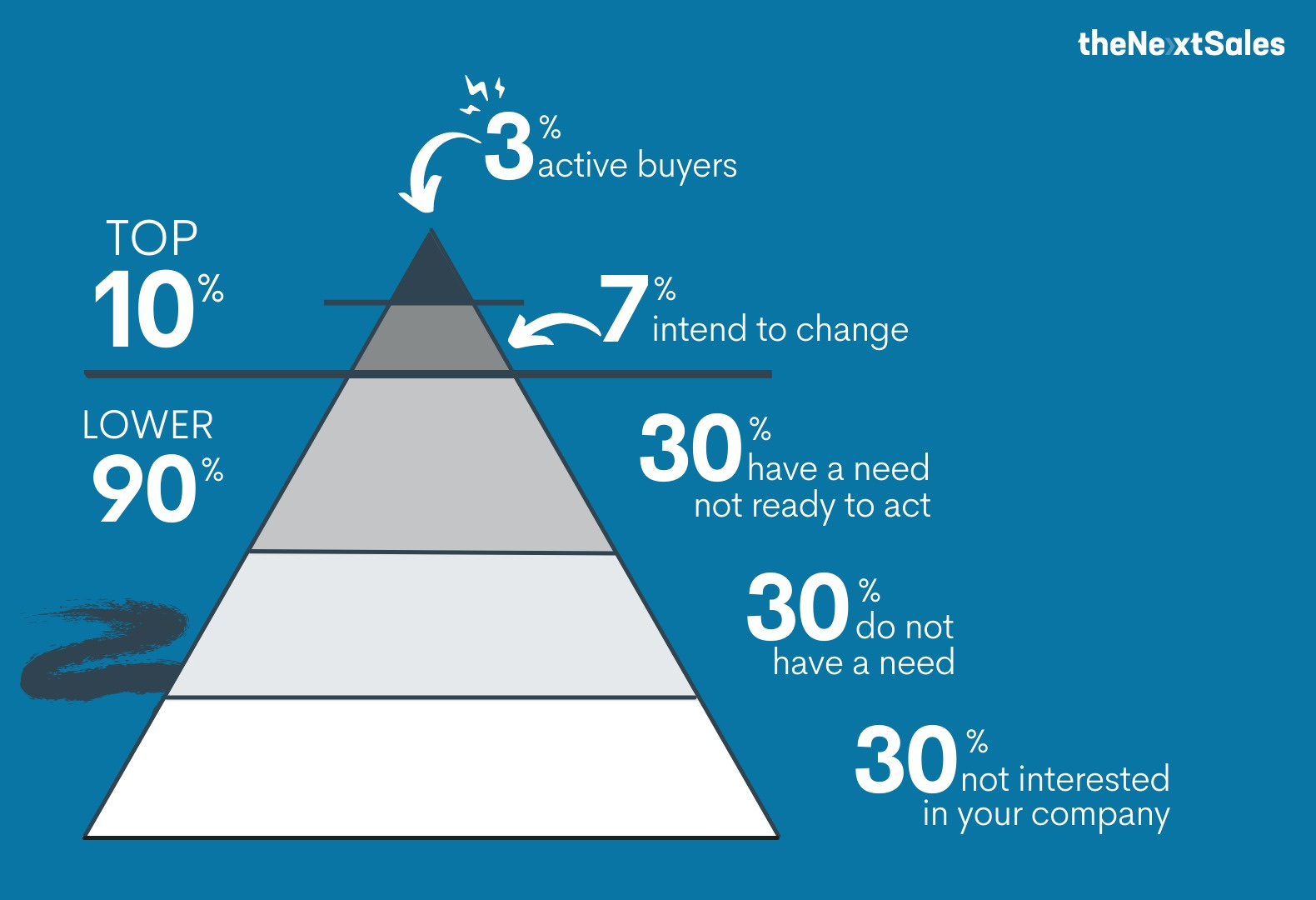
And which prospects should a sales rep focus their time on? Because only 3% are ready to buy at any given moment.
It is therefore no surprise that account-based marketing is gaining ground due to increasing complexity and scarcity.
In addition, there are many misunderstandings and assumptions that contribute to ongoing confusion regarding definitions related to prospecting, and there is often no clear-cut approach to prospecting, which results in a significant loss of time.
This article provides a more detailed explanation of the many definitions of prospecting and a concrete approach to your prospecting activities, but let’s start with some practical prospecting tips before discussing the following topics in greater depth.
- Prospecting: Meaning and Definitions
- Stakeholders and Personas in B2B
- What are the key steps in prospecting?
- The Prospecting Playbook
- LinkedIn First Approach & Examples
- What the prospecting figures don't tell you?
Embedded video
This video is hosted by another company. As soon as it loads, that company sees your IP address and sets its own cookies.
Definitions of Prospecting
The term “prospecting” evokes a lot of discussion among marketers and sales professionals. It is, in fact, a very broad topic and, as a rule, the most complex phase within the marketing and sales process—if only because there is always debate about definitions that are directly or indirectly related to the prospecting phase. In this chapter, we present our top 3.
1 – Suspect vs. Prospect
A suspect is actually a potential prospect.
With a "suspect," you literally have a "suspicion" that they might be an interesting prospect.
But ultimately, you won't know that until you know which organization it is and whether that organization meets the qualification criteria for a prospect.
Ultimately, you want to focus only on companies that have the potential interest and ability to buy from you.
2 – How do you qualify a prospect?
Prospects are qualified by first determining the criteria that the ideal customer (ICP) must meet. Prospecting can then be carried out through targeted outreach via phone, email, video messages, or targeted marketing campaigns.
It is also possible to categorize B2B prospects into different tiers, but if there is any doubt about the “match,” it is better to label a company as “suspect” and do more research to ultimately disqualify or qualify it as a prospect.
For example, a disqualification may occur because the company has been acquired or because of liquidity problems that make prospecting less valuable.
3 – Prospect vs. Lead
A prospect is a company.
And a lead is a person.
So you might have a qualified prospect whom you'd like to have as a customer, and by definition, you'll also have a clear understanding of who your leads are.
At the same time, this lead is only considered qualified if the person is actually interested in exploring a topic or solving a problem.
If this is the case, then we are talking about a qualified lead according to the criteria established by the sales organization.
Lead Qualification and Definitions
Each organization decides for itself which lead qualification method to use, but before qualifying leads, it is important to establish clarity and consistency regarding lead definitions within the organization and the associated responsibilities. Below is a list of the most common lead definitions.
Lead: A contact at a suspect or prospect. The contact information is known, but the lead has not yet been qualified.
Marketing Qualified Lead (MQL): a contact at a prospect or customer who has shown a certain level of interest in a product or service.
Sales Accepted Lead (SAL): The sales team has had the opportunity to accept the lead and, in doing so, has committed to following up with the prospect or customer.
Sales Qualified Lead (SQL): The lead is qualified after the salesperson has spoken with the prospect or customer.
Stakeholders and Personas in B2B
Personas are crucial in B2B sales cycles for navigating their long duration and complexity. A “Sales Champion” persona—the internal advocate within a customer’s company—is essential for successful prospecting. This person helps sell your product or service internally and convinces decision-makers.
Using a Sales Champion persona helps you target and engage potential customers on platforms like LinkedIn. By matching the characteristics of your Sales Champion with LinkedIn profiles, you can make relevant connections and increase your sales opportunities.
For practical tips on how to go about this, check out my video via the link below. In it, I demonstrate how you can use personas to select prospects on LinkedIn.
Embedded video
This video is hosted by another company. As soon as it loads, that company sees your IP address and sets its own cookies.
A Seven-Step Prospecting Strategy
For any approach, a systematic method helps you be more effective. While there are many steps involved in prospecting, these 6 steps provide enough guidance to get you off to a good start.
1 - Define the Ideal Customer Profile (ICP)
There are many different types of people, industries, and company sizes, and in the Netherlands alone, there are more than 5,000 small and medium-sized enterprises (SMEs) with more than 100 employees.
So how do you know where to start?
“Think before you act.”
What is your strength, and why do customers buy from you? And why aren’t you succeeding in a specific target market? Is it a lack of references, or a lack of “cultural fit”?
The chances that a prospect is a good fit for you are often much lower than you think. And the painful part is that customers are even more critical than your most pessimistic scenario.
Furthermore, salespeople are often inclined to jump right into prospecting too quickly, when a thorough preliminary investigation could have already ruled out many prospects.
2 – Prospect Qualification
Effective prospect qualification makes it easier for salespeople to demonstrate relevance during the sales process.
The prospect most likely resembles a number of existing customers, making the situation highly familiar to the prospect. It also makes things easier for the salesperson, as they can draw on the knowledge and experience already available within the organization.
Below are a few random examples that can be used for further clarification.
- Does the prospect's ambition align with the service or product to be provided?
- Based on its financial situation, is the organization able to “buy”?
- Are the desired stakeholders present within the organization?
- Does an organization have a specific technological infrastructure?
- Is there local authority to make the purchase?
3 – Communication Channels
If you’ve been in business for a number of years, prospecting is, in theory, easier. This allows you to reflect on where you’ve met your most valuable prospects. And you can ask yourself whether this is still relevant. For example, was it at that annual trade show, an in-house event, on social media, or actually through cold calling?
Chances are, most of your potential customers are on LinkedIn. That means it’s easier to engage with them, since LinkedIn offers many ways to connect. Now that you know where to find your ICP, it’s important to tailor your prospecting activities accordingly, with the primary goal of building trust.
4 – Building Trust
It’s tempting to jump right into your pitch. After all, this is the part you’ve mastered and feel comfortable with, but for the person receiving your message, it’s often off-putting—unless you’re actually calling to tell them that your prospect has won a million euros.
Build a relationship before you contact them—for example, by phone—so you’ll have more opportunity to share your story. You can do this through social media or by sending a personal video message.
5- Personalize your message
Always start with the other person. In practice, this means, for example, that you should never begin an email, phone call, or video message with “I.” It’s also a good idea to first explain why you’re reaching out and to show that you’ve taken the time to learn about the person or organization before asking a question or presenting your solution.
One good professional way to personalize a message, for example, is to refer to a company’s annual report (if it has been published, of course).
6 – Pitch Your Question
Timing is key when prospecting. Build the relationship first so you have something to fall back on if your first attempt to set up a meeting fails. There’s a good chance your pitch won’t get through if you don’t personalize your message or if you lack situational authority entirely. A prospecting tip:
Don't do that
My name is…
We help sales teams build trust more quickly through a methodical approach. Would you be interested in taking a few minutes to explain how we do this?
Do
My name is…
We see that sales professionals spend 30% of their time on prospecting-related tasks, and that each salesperson uses a manual approach, resulting in minimal predictability.
What are your thoughts on a systematic prospecting approach if it can lead to a more accurate forecast?
7 – The Agenda
The number of “no-shows” has increased in recent years because it’s easier to schedule a meeting online, for example. Confirm your appointment and be sure to include a calendar reminder to help your prospect remember why this meeting is important. Do this before you start that first 30-minute digital presentation, which is simply impossible to manage if you don’t know what to expect beforehand.
Don't forget that every meeting is an opportunity to influence others and that an agenda gives you "frame control. "
In theory, you can build a relationship with a prospect, but in practice, this is actually impossible. That’s because relationships result from interactions between people who fit your ideal customer profile or who are prospects.
The seven prescribed prospecting steps describe the phases, but not the specific activities. The number of actions you need to take in practice—for example, to build trust—is often a series of small follow-ups. And this principle also applies to a number of other steps in this conceptual process.
The Prospecting Playbook
The goal of a prospecting playbook is to generate leads, but a transactional message is hardly effective. Email, cold calling, or social media are only effective when used with the right intent and in the correct order. Below are a few prospecting tips you can always use.
Personal: It always starts with the other person. What makes you interested in this specific contact without resorting to your “copy-paste” skills? And are you able to see this lead as a person, or just as a buyer persona?
If you choose the personal approach, your options for being relevant are many times greater, because you can build on shared personal interests, for example.
Approach: A social selling approach allows you to build relationships online more quickly. Through social listening, you’ll be better able to personalize your messages based on the person’s LinkedIn profile, posts, recommendations, and comments.
Valuable: You’ve already determined early on that you want to invest time in certain prospects because you’re convinced you can be of value to them. Personalization is therefore much easier once you’ve incorporated the ICP step into your prospecting approach, since the qualification—and thus the relevance—has already been determined in advance.
Approach: Video prospecting is the most effective way to demonstrate your value, because it immediately gives your prospect the opportunity to get to know you as a person.
Decisive: Sales is all about winning deals, but only if you bring it up. You can personalize your approach and continue to provide value, but there comes a point when you have to be decisive to turn your prospecting efforts into an appointment.
Approach: Cold calling is still the most effective approach, provided you’re able to reach your contact person. The likelihood that they’re currently on the phone is five times higher. The effort you’ve put into personalizing your message, combined with a video, will lead to the ultimate reward.
Prospecting Examples
To illustrate this, we’ve included four examples of prospecting where we personalized each message via LinkedIn, added value with video, and followed up by phone. Here’s a brief summary of the results:
Example 1: Problem with download link
I tried to get in touch with the CMO of a leading Dutch IT company. Despite my attempts via LinkedIn and email, I didn't receive a response. Furthermore, I didn't have a direct phone number.
So I turned to the company's website. While I was gathering information, I tried to download a white paper. To my surprise, the link didn't work. This was my chance.
I know how much work goes into a white paper, and it's a shame if it's not accessible.
My Prospecting Approach
I reached out to their lead marketer on LinkedIn. I immediately brought up the issue with the white paper download. I avoided any sales pitch, but I did get their attention.
After two days, I got in touch again.
“Dear [Name], I’ve created a special video for the CMO. Would you mind sharing it?”
As a little bonus, I added a few bloopers from my previous video shoots.
It just goes to show: a little humor never hurts.
Give first, and then you will receive.
Why did it work?
Since he had received some value first, it was harder for him to turn down my offer of help when I asked. And on top of that, he appreciated the small investment I had made.
Just like at the end of the personalized video, I also included a few personalized bloopers, which made it even easier to break the ice.
Always give first…
Example 2: Not active on social media
In this case, I wanted to get in touch with a senior marketer at a Dutch IT company.
And the challenge I faced was that he wasn't very active on LinkedIn. His last post was about two years ago, and the information on their website was quite formal and not suitable for a fun post.
They didn't have any notable statements or quotes, nor any recent company updates. Furthermore, I couldn't find any notable statements from my intended contact person either.
After doing some searching on Google, I found out that he had played guitar for a Dutch band in his spare time. And he wasn't half bad, either… Does anyone know the song “The Fast Lane”?
First, I sent him a message on LinkedIn titled “The Fast Lane,” and that’s probably why he opened my message and why I caught his attention.
Next, I demonstrated my creativity by combining his personal interests with his role as a marketer—the ultimate combination for connecting with people on both a rational and emotional level.
And instead of sending the personalized video I made for him in the first message, I decided to take a different approach.
I found the message intriguing and asked him if he'd like to receive the personalized video.
And finally, I used the PS to go a little off-topic to increase my chances of starting a conversation.
A combination of creativity and the effort I put into reaching out to him. And second, I kept my message intriguing, which brought his curiosity to a sort of boiling point.
Example 3: A CEO with a mission
In this case, my prospect was the CEO of a Dutch company that provides IT solutions for the hospitality industry and has about 50 employees.
And to be honest, I couldn't find anything about my prospect on Google. He wasn't very active on social media either.
And then I saw a great quote that must have been from the CEO:
“People make the difference”
Now, here at theNextSales, we share the same vision, so I was also able to form a picture of this person—who he was, what his values and principles were, and so on.
First, a LinkedIn invite without a personal message. After he accepted my invitation, I sent him a very brief personal message.
I figured that, since it was a small company, the CEO was probably involved in what goes on the homepage. So he knew right away that my message was extremely personal.
And he didn't realize that the tagline for his website had been copied, and months later, after our first project, he asked me how I actually knew…
Of course, they're both laughing.
Example 4: Prospecting the VP of Sales
In this case, my prospect was the VP of Sales at an international security company, and he was very active on LinkedIn—he liked almost everything, shared a lot, posted, commented, you name it.
So my challenge was to figure out which of his activities were most relevant to the story I wanted to share with him. I noticed that he had recently shared a post in which he expressed pride in one of his colleagues who had discovered a security vulnerability in the Citrix system, because it was a major achievement for them. He was also emotionally invested in this post, and I knew how to grab his attention.
Let me explain it to you. So my first contact with him was through LinkedIn, but unfortunately he didn't accept my invitation, so I just sent him an email.
Let's see. So first of all, instead of talking about myself like many salespeople do—saying, “I saw on your LinkedIn profile that blah, blah, blah”—I changed that.
I started by talking about him and his recent post. That way, I got his attention, and it probably increased my chances that he would open my email.
Then I tied his story to mine—which is a sales hack—but I kept it intriguing. So he still wants to know what it’s all about.
The animated thumbnail—a preview of the personalized video I made for him—added another layer of hyper-personalization, and finally, I included a P.S. at the end of the message to keep things lighthearted and make it easier for him to reply and start a conversation.
Why did this work? Of course, creativity played a big role, but it also felt like a natural way to connect. When I came across this post and was working on it. And the more recent the activity, the more relevant your post.
Sales Prospecting on Steroids
Establishing a connection through a referral is the fastest way to build trust, which is why extensive personalization isn’t always necessary; however, the methodical approach outlined earlier generally remains the standard.
What was our prospecting approach?
1. Make a list of interesting people whom your top 10 referrers might know. 2. Schedule meetings with these referrers and discuss any interesting referrals with them. 3. Use the referrer without going into too much detail and send the video
In this case, I was referred by a friend, and the appointment was scheduled that same week.
TIP: When asking for a referral, keep in mind the value it brings to the other person.
Don't: Can you help me? Do: Would your relationship benefit from…
Referrals have the highest conversion rate for booked meetings and the number of times the video has been viewed. It takes a little more time to prepare, and the approach needs to be “smooth”—incidentally, slightly different rules apply to a company-wide referral program.
What Do Sales Prospecting Numbers Not Tell You?
The number of appointments booked following a referral was only 10% higher.
However, the number of deals resulting from a referral was three times higher than those without a referral.
Three decision-makers said that gaining buy-in was easier because of the use of video.
Sending videos alone generates up to 10% spontaneous responses without scheduling a meeting.
Hard-sell CTAs with video hardly work at all—the barrier to entry is lower, but that doesn't matter.
To be effective, only create a video if you're connected on LinkedIn—learn more about LinkedIn video metrics.
Making videos isn't always about time—it's more about energy.
Video made us feel like we were providing a lot of value, and customers admitted afterward that they felt the same way.
Prospects wanted to give us something in return for the time we had invested.
A follow-up conversation after a video call didn't require a polished pitch, because the work had already been "delivered."
Conclusion
Prospecting in sales is about making choices and then going all out. Make sure to build multiple relationships with the prospects you’ve identified.
Act quickly and be flexible in your approach, but don’t wait around. The phone remains a “weapon” when used with the right call script(and only at the right moment). And yes, always combine it with social selling—and preferably include a video message in the mix. You want to stand out, stay top of mind, and win the client’s favor.
As an account manager, think this way even if there isn’t an “invoicing relationship” yet, and opt for an ABM approach, because you don’t have the luxury of serving the entire world. And besides… stakeholder management is “complex,” to say the least, so don’t overestimate the number of companies you think you can manage during the prospecting phase.
Adopt a systematic approach to sales prospecting and give your prospects the opportunity to meet with you in settings where they feel comfortable. This could be on LinkedIn, via email, at the annual event, in that trade journal, or any other place where your prospects are regularly present—and feel at ease.
Personalizing your messages will earn you credibility, but be aware that your prospects are ultimately expecting your sales pitch. Don’t fall into this trap—replace your sales pitch with an intelligent question that compels your prospects to actually engage with you right now.
You’ll know you’re on the right track only when you know more about your prospect than your prospect knows about you. This will give you control over how things unfold and increase your chances of developing a better opportunity. And always do this with a forward-looking mindset.
My name is Effy Shkuri, and we’ve found that sales professionals need to make 20 attempts to secure just one meeting. How appealing would it be for you to use our “Prospecting NEXT” approach if you could secure 5 meetings for every 20 attempts?
Most Frequently Asked Questions
How can we leverage social proof and testimonials in our prospecting efforts?
Using social proof and testimonials can be a powerful addition to prospecting strategies, as it can build trust and credibility with potential customers. Here are some ways sales teams can do this:
- Case Studies and Testimonials: Share stories and testimonials from existing, satisfied customers—especially those in the same industry or facing similar situations as the prospect. This can help a prospect envision themselves benefiting from your product or service.
- Case Studies: Create detailed case studies that showcase specific examples of how your product or service has helped customers. Highlight concrete results and measurable indicators of success.
- Logos of well-known clients: If you have well-known companies or brands as clients, display their logos on your website and in your marketing materials. This can serve as an implicit endorsement.
- Social Media: Use social media channels to share success stories and showcase your interactions with customers. Authentic interactions and recommendations on social media can attract potential customers.
- Referral Programs: Set up a program that rewards current customers for referring new customers. This can encourage your existing customer base to actively contribute to your prospecting efforts.
- Video Testimonials: Videos of satisfied customers sharing their experiences are particularly persuasive and add a personal touch to the testimonial.
- Press and Awards: Include any press releases or industry awards your company has received in your communications, as this helps build your credibility.
- Influential References: If you have endorsers with a strong reputation in the industry, such as well-known business leaders or industry experts, be sure to include them in your prospecting materials.
By strategically integrating social proof into your sales processes, sales teams can strengthen their ability to persuade and reassure prospects about the quality and reliability of their offerings. It is important that these tactics be used in a way that is genuine and relevant to the prospect’s needs and interests.
How can we improve our response rates for cold outreach?
To improve response rates to cold outreach, salespeople can consider the following strategies:
- Personalization: Include specific information about the prospect or their company in your messages to show that you've done your homework and are genuinely interested in them as a customer.
- Focus on Value: Make sure your communication clearly highlights the value your product or service can offer the prospect. The key is to immediately show how you can help them solve their problems or improve their situation.
- Keep it short and to the point: Long messages often go unread. Keep your outreach brief and to the point.
- Timing: Identify the best times to reach your target audience and adjust your outreach schedule accordingly.
- A/B testing: Experiment with different messages and approaches to see what resonates best with your target audience. Use the data to refine your approach.
- Follow Up: A single message is rarely enough. Develop a systematic follow-up strategy to increase the likelihood that your messages will be seen and responded to.
- Use of Technology: Implement tools that help track emails and engagement so you can see who opens your messages and when, and take appropriate action.
- Training and Development: Invest in training for your sales staff so they can improve their communication skills and become more effective in their outreach efforts.
These methods can help increase the response rate and can be adapted and refined over time to achieve the best results.
How can we ensure consistent follow-up without being pushy?
Ensuring consistent follow-up without being pushy requires a balance between persistence and respect for the prospect’s time and interest. Here are some strategies that sales teams can use:
- Add value with every interaction: Make sure every follow-up provides new value to the prospect. This could take the form of relevant information, an answer to a previously asked question, useful insights, or a personalized demonstration.
- Timing and Frequency: Establish a follow-up schedule that takes the prospect’s responses and preferences into account. Use their feedback to adjust the timing—if someone indicates they’re busy, ask when would be a better time to reach out.
- Clear Communication: Be transparent about the follow-up process. Let the prospect know when and how you plan to get back in touch. This sets clear expectations and respects their time.
- Listen and Adapt: Pay attention to the prospect’s responses. If they don’t seem interested or ask you to stop contacting them, adjust your strategy accordingly or move them into a long-term nurture campaign with less frequent contact.
- Use a variety of channels: Alternate between email, phone calls, social media, and even direct mail. This can help keep the message fresh and reduces the risk of coming across as pushy.
- Personalized Approach: Tailor your follow-ups based on the prospect’s specific interests and needs. This shows that you understand their situation and value their time.
- Respect a “no”: If a prospect makes it clear they’re not interested, respect that. Ask if you can reach out to them in the future or if they’d be interested in receiving information on a specific topic.
- Automated follow-up: Use CRM systems to automate your follow-up without losing the personal touch. Well-configured automation can help you stay consistent without being too pushy.
- Ask about preferences: Ask the prospect how they prefer to communicate and how often. This shows respect for their preferences and can help build a relationship.
- Set expectations: If you've proposed a follow-up plan and the prospect has agreed to it, stick to that plan. This builds trust and demonstrates your reliability.
The goal is to be helpful and considerate in your follow-up efforts. Striking the right balance between being persistent and giving people space is crucial for building relationships with potential customers without scaring them off.
What is the biggest pitfall?
The biggest pitfall in prospecting is prioritizing quantity over quality. Salespeople can get caught up in chasing as many leads as possible without focusing on the right fit for their product or service. This approach often leads to inefficiencies and missed opportunities, because a lot of time is spent on leads that will never convert.
The key is finding a balance: qualifying prospects so that time and energy are invested in the most promising relationships. It’s not just about how many contacts you make, but about the relevance and timing of your message. A personalized, attentive approach that truly listens to the prospect’s needs is essential.
So the real danger isn’t failing to find leads, but failing to identify the right leads and respond to them effectively. Prospecting requires consistency, attention to detail, and a strategy that builds quality relationships—not just a list of potential customers.
What is the most effective prospecting method?
Effective prospecting is all about a personalized approach; it requires researching prospects, understanding their needs, and adding value with every interaction. The best salespeople mix communication channels and time their follow-ups well to build trust without being pushy. Humanity is key: making genuine connections is what sets a one-time sale apart from a long-term customer relationship.
How long should the prospecting phase last in B2B before you disqualify a lead?
My advice is not to spend more than 3 months trying to identify the Champion when prospecting. I would only make an exception for this if you’ve designated a specific account as a top priority as part of an ABM program, because in that case the focus isn’t on the transaction but first and foremost on the relationship.
Effy Shkuri
"Our people make the difference." Really? As a former "digital workplace & IT entrepreneur," I've said this for years about my 25 colleagues. But the reality is we were only considered thought leaders by 5% of our target audience. Even today, this remains a common statement from MSPs and IT service providers. But these words lose their meaning if your expertise does not extend beyond your existing customers and a handful of prospects. I now help IT entrepreneurs with thought leadership in their niche.